Case file
Medicine collisions
A fictional patient's seven medicines laid out by when each was actually acting, with her condition from the chart on the same axis. Interactions are marked where they overlapped in time and labelled as happened, averted by the team, or checked clear. In this record it finds a gap in antibiotic cover after a vomited dose and a clarithromycin and amlodipine overlap that no note mentions. 103 tests. Not a medical device.
- Author
- Henry CartoMSc · Software, Medical & eHealth Engineer
- Role
- Design and engineering.
- Stack
- React · TypeScript · Vite · SVG · Vitest
- State
- Live, fictional patient.
Problem
Interaction checkers work on lists. They see two drugs on a medicine chart and raise an alert, whether or not the two were ever in the body at the same time. That alert fires so often it gets clicked through. This map asks a narrower question: did these two things overlap, for how long, and did anyone do anything about it? Every medicine the patient received is laid out by when it was acting rather than when it was charted, and each interaction is labelled as having happened, been averted by the team, or been checked and found clear.
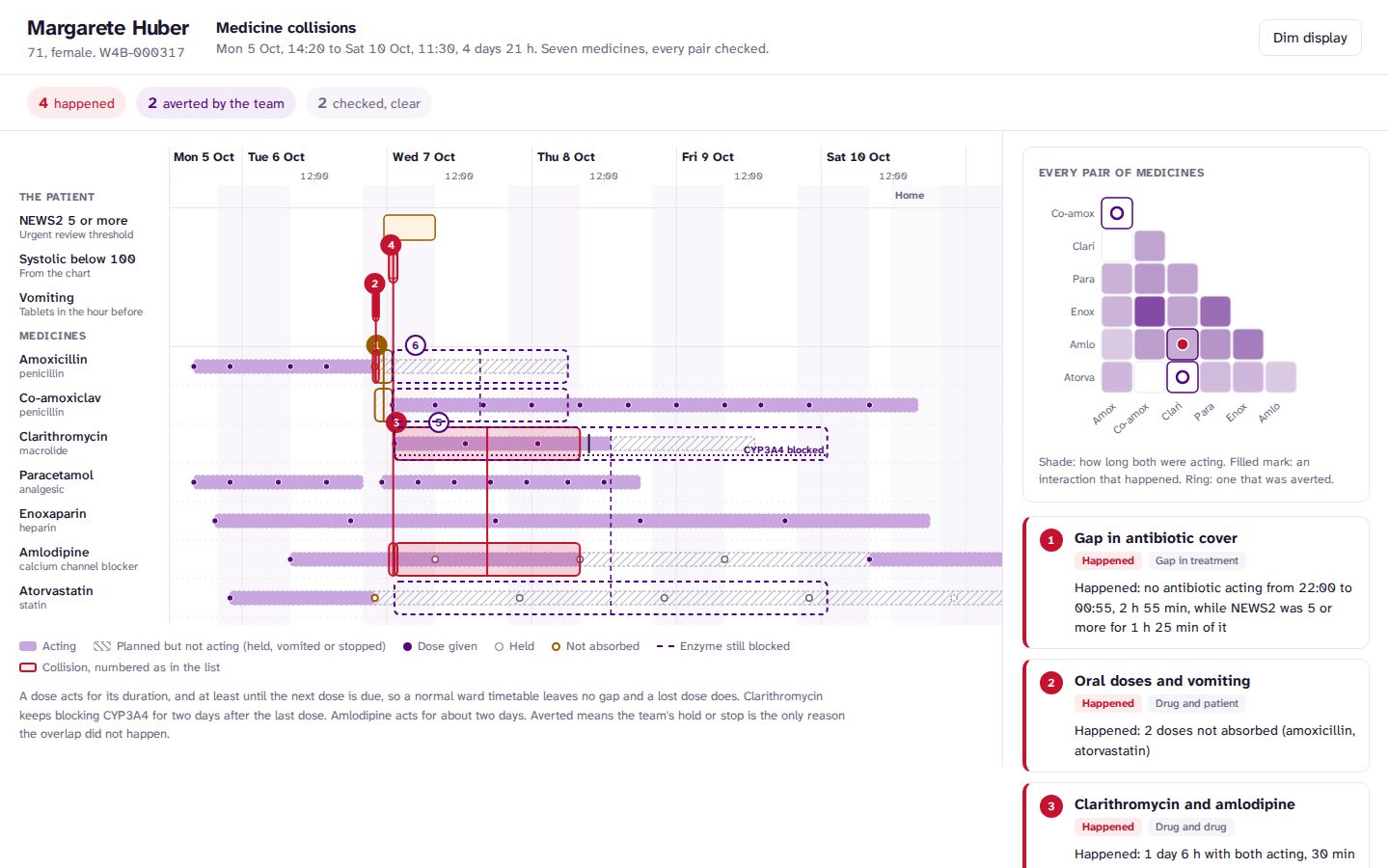
The whole stay. Seven medicines and the patient's condition on one time axis, with six collisions bracketed between the lanes they join and every pair of medicines in the matrix.
Four decisions
Exposure, not orders. Each dose acts for its duration, and at least until the next dose is due. A normal ward timetable (08:00, 14:00, 22:00) leaves no gap, but a vomited dose does. Amlodipine acts for about two days. Clarithromycin keeps blocking the CYP3A4 enzyme for two days after its last dose, and that window is drawn on its lane.
Happened, averted, clear. Every collision is computed twice: once on what was given, and once on what was due (held doses, vomited doses, and the doses a stopped medicine would have continued with). If it overlaps only on what was due, the team's hold or stop prevented it, and the map says which one.
Conditions are lanes too. Low blood pressure, vomiting and a NEWS2 of 5 or more come from the observation chart. They collide with medicines the same way medicines collide with each other.
Every pair, shown. A matrix of all 21 pairs is shaded by how long both drugs were acting together and marked where an interaction is known. Pairs that overlapped with no known interaction are visible too, so nothing is hidden by omission.
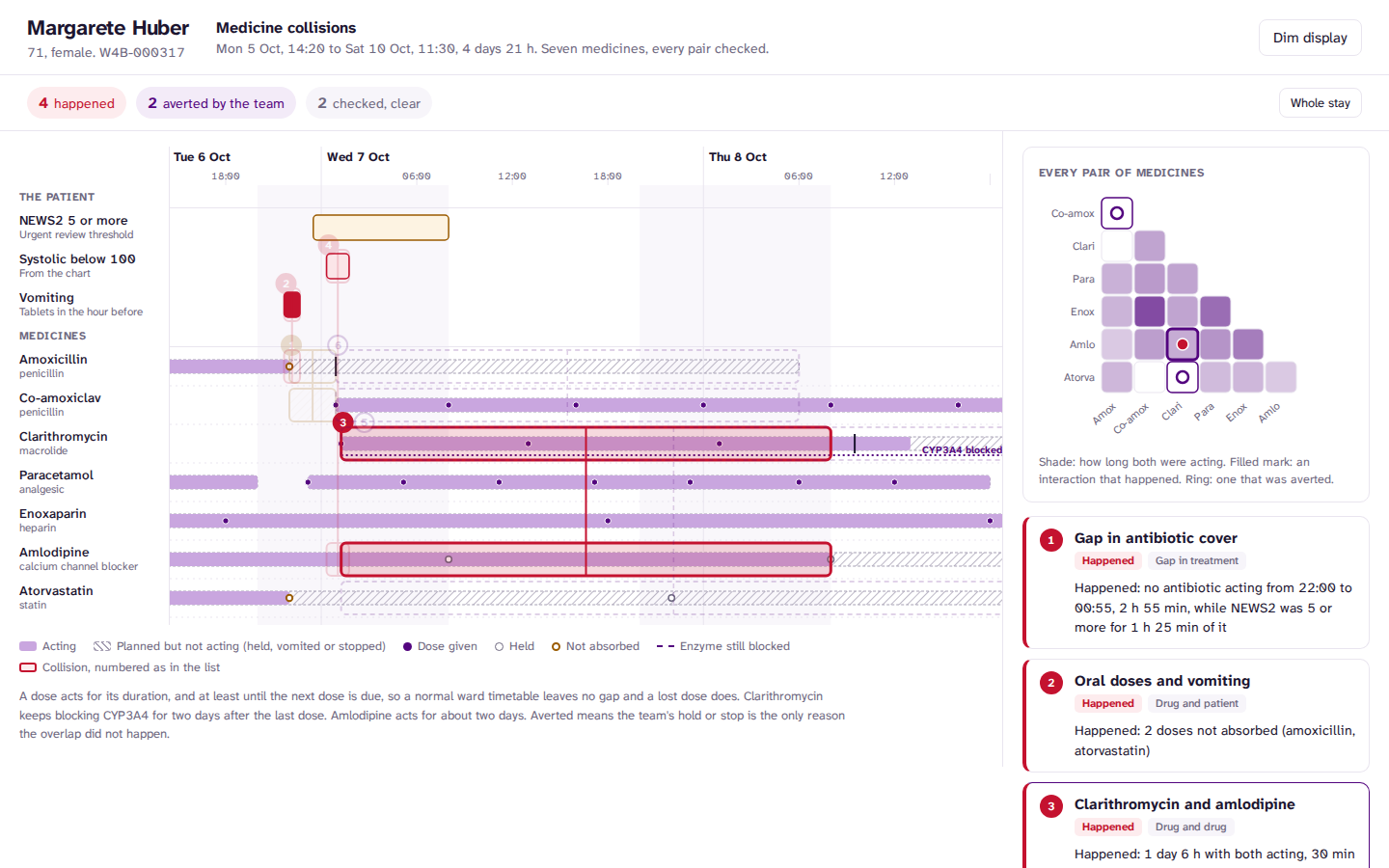
Zoomed to clarithromycin and amlodipine. Tuesday's amlodipine dose was still acting when clarithromycin started, and holding amlodipine for low blood pressure cut the overlap from nearly three days to one.
What it finds
The same fictional patient as the Ward 4B monitor, the patient timeline and the decision cockpit.
| # | Collision | Status | From the record |
|---|---|---|---|
| 1 | Gap in antibiotic cover | Happened | No antibiotic acting from 22:00 to 00:55, 2 h 55 min, and her NEWS2 was 5 or more for 1 h 25 min of it |
| 2 | Oral doses and vomiting | Happened | Amoxicillin and atorvastatin taken within the hour before she vomited; neither was replaced |
| 3 | Clarithromycin and amlodipine | Happened | 1 day 6 h with both acting, 30 min of it with systolic below 100. No note mentions it. Holding amlodipine cut it from 2 days 23 h |
| 4 | Amlodipine and low blood pressure | Happened | 1 h 25 min with systolic below 100 while Tuesday's dose was still acting |
| 5 | Clarithromycin and atorvastatin | Averted | The pharmacist's hold avoided 2 days 23 h of overlap; the restart at home falls 21 h after the enzyme block ended |
| 6 | Amoxicillin and co-amoxiclav | Averted | Amoxicillin was stopped as the first co-amoxiclav dose went in |
| 7 | Paracetamol daily limit | Clear | At most 4 g in any 24 hours, doses at least 6 hours apart |
| 8 | Kidney function and doses | Clear | Lowest eGFR 47, above the threshold of 30 where doses change |
Row 3 is the one worth building this for. The team held amlodipine for low blood pressure, which was right, but the dose given on Tuesday morning was still acting when clarithromycin started, and clarithromycin raises amlodipine levels. Nothing in the record connects the two. A list-based checker would have flagged the pair on the chart regardless. This map shows when it was real, for how long, and how much the hold reduced it.
How it decides
- Intervals. Exposure, conditions and collisions are sets of time intervals. Merge, intersect, subtract and gaps are small, pure, tested functions.
- Exposure. A given dose acts from its time to whichever is later: its duration, or the next due dose (within 1.5 dosing intervals).
- What was due. All charted doses, whatever their status, plus one day of doses a stopped medicine would have continued with at its usual interval.
- Averted. The actual overlap is zero and the overlap on what was due is not. Each counterfactual changes one drug at a time, so an averted collision is credited to the hold or stop that prevented it.
- Vomiting. Oral doses in the hour before vomiting count as not absorbed. The tests check that this rule picks out exactly the doses the nurse recorded as not retained.
- Antibiotic cover. The union of all antibiotic exposure, with its gaps between the first and last dose.
- Checks. The highest paracetamol total in any 24 hours, the shortest gap between doses, and the lowest eGFR (CKD-EPI 2021) against the renal dosing threshold.
The interaction table is small and curated for this patient's medicines, simplified from standard references. Each entry carries its mechanism and the action it calls for.
Tested
103 tests. 46 of them are the shared NEWS2 band edges. The rest cover:
- interval operations
- exposure through the ward timetable, held doses, vomited doses and stopped medicines
- the enzyme-inhibition tail
- every collision's status, interval and wording
- the vomiting rule against the recorded dose statuses
- ordering
- the integrity of every lane, event and interaction reference
The first version of the exposure model treated the overnight interval between 22:00 and 08:00 as a gap in antibiotic cover. It flagged two false gaps in a normal timetable. The rule is now that a dose covers until the next one is due.
Design
Same design system as the ward monitor, the timeline and the cockpit: white, one purple for interaction, Atkinson Hyperlegible Next bundled with the app. Red marks what happened, purple dashes mark what was averted, amber hatching marks a gap, and grey marks a check that came back clear. Selecting a collision from the map, the matrix or the list fades everything else. Zooming eases into the collision's window. Dim display follows the system or the button. On a phone the map scrolls sideways under fixed lane labels, and the list sits below.
?c=clarithromycin+amlodipine on the URL opens with a collision selected.
Not a medical device
A fictional patient and a small curated interaction table, for demonstrating interface design and the logic behind it. It is not prescribing advice, it is not validated, and it must not be used to make clinical decisions.