Case file
Decision cockpit
NEWS2, CURB-65, the sepsis red flags and kidney function drawn as live circuits feeding six bedside decisions for one fictional patient. Every value is a what-if control, and every decision shows the smallest change that would turn it into a different one. At the four decision moments in her record, the rules reproduce what her notes record. 110 tests. Not a medical device.
- Author
- Henry CartoMSc · Software, Medical & eHealth Engineer
- Role
- Design and engineering.
- Stack
- React · TypeScript · Vite · SVG · Vitest
- State
- Live, fictional patient.
Problem
Decision support usually fails in one of two ways. Either it is a black box that outputs a score nobody can argue with, or it is an alert that fires without saying why. This cockpit does the opposite. A patient's values flow through NEWS2, CURB-65, the sepsis red flags and kidney function into six bedside decisions. It shows the whole chain from a measured value to a recommendation, and lets you push on it. Every lit wire is a reason, and every decision shows the smallest change that would turn it into a different one.
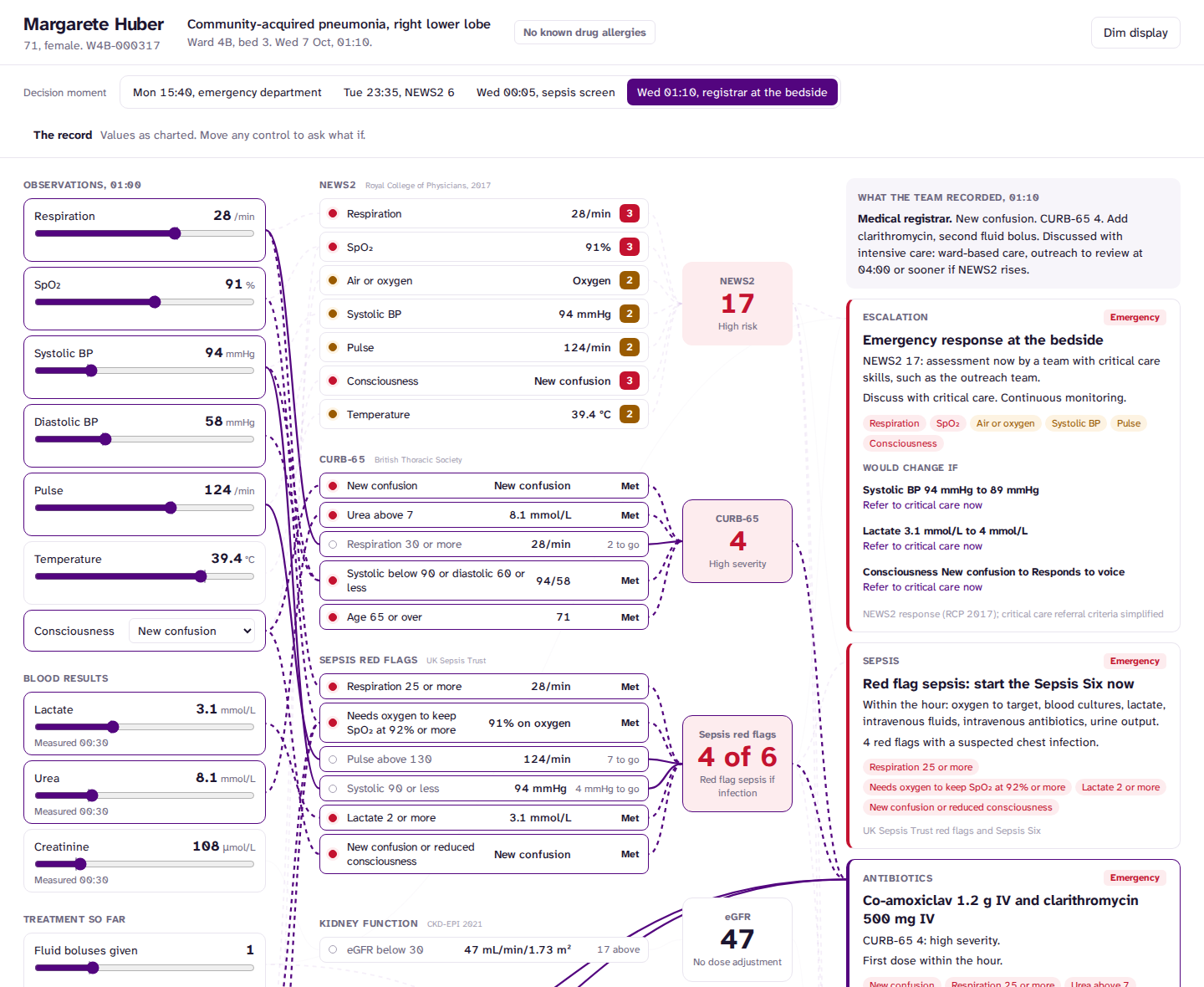
Wednesday 01:10, the registrar at the bedside. NEWS2 17, CURB-65 4 and four red flags, with every criterion that is met lit and wired through to the decisions it feeds.
Four decisions
Rules as circuits. Each criterion is a node that lights when it is met. It shows its value and how far it is from firing ("pulse 124, 7 to go"). Wires carry what is met into each score, and from the scores into the decisions. Hover any node to trace what it depends on and what depends on it.
What if. Every value is a control, with the charted value marked on its track. Drag the systolic from 94 to 89 and the escalation turns from an emergency response into a referral to critical care. The changed decision says what it was on the recorded values. A what-if scenario lives in the URL, so it can be shared.
Tipping points. For each decision, the cockpit finds the smallest single change to any input that would change the recommendation, by walking each input away from its value in both directions. At 01:10 escalation is 5 mmHg of systolic, or 0.9 mmol/L of lactate, away from critical care. Click a tipping point to try it.
Checked against the record. It uses the same fictional patient as the Ward 4B monitor and the patient timeline. At each of the four moments in her notes where a decision was made, the cockpit reads her charted values and shows what the team wrote beside what the rules recommend.
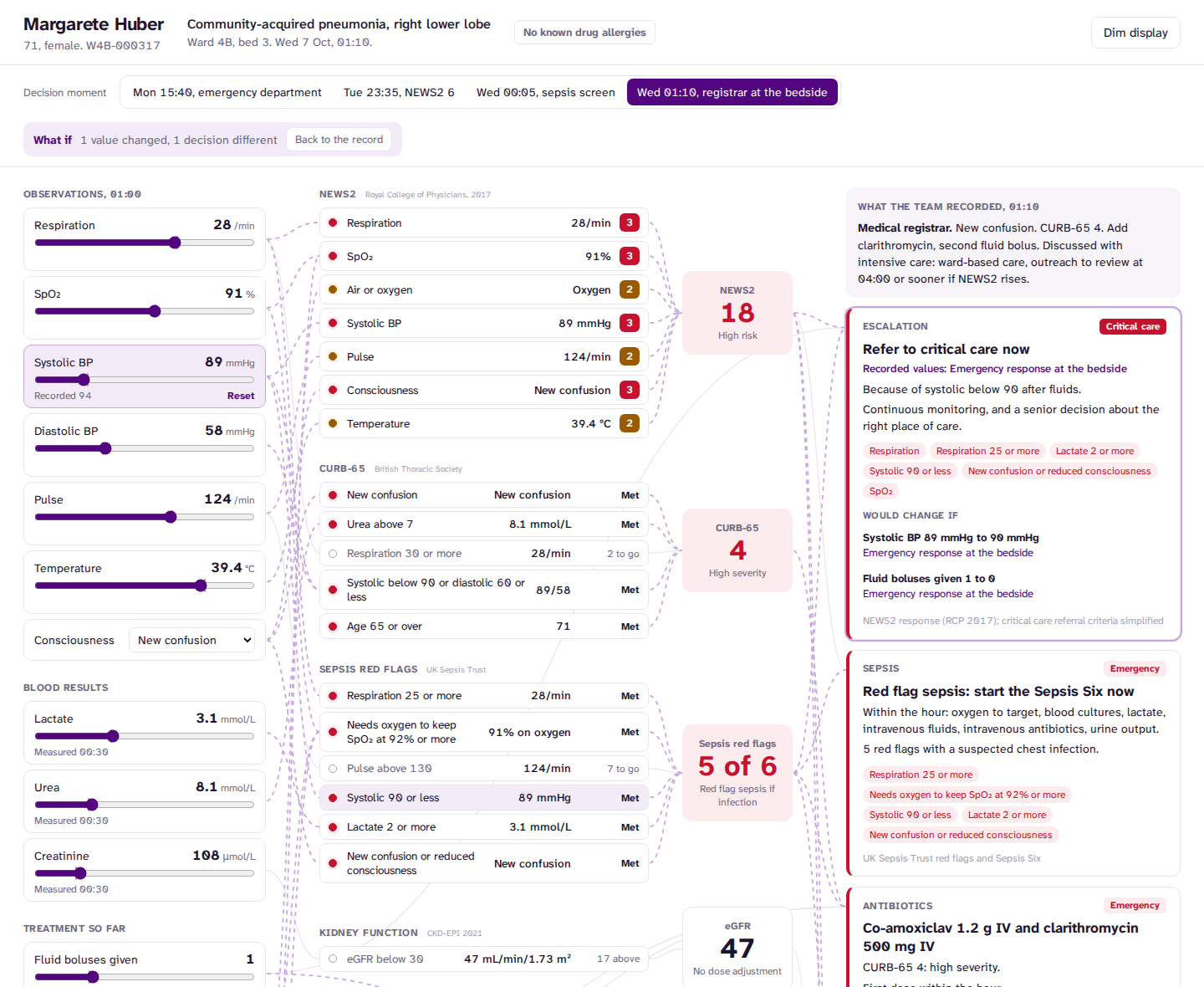
What if her systolic were 89. Escalation becomes a referral to critical care, the card says what it was on the recorded values, and the bar counts one value changed.
The four moments
| Moment | Charted | The rules recommend | The team recorded |
|---|---|---|---|
| Mon 15:40, emergency department | NEWS2 3, CURB-65 1 | Oral amoxicillin, ward care | Oral amoxicillin, admitted |
| Tue 23:35, after vomiting her 22:00 tablets | NEWS2 6, no lactate for 33 hours | Urgent review; give the lost amoxicillin dose intravenously; start oxygen | Doctor asked to review, hourly observations |
| Wed 00:05 | NEWS2 10, 2 red flags | Red flag sepsis, Sepsis Six, measure lactate, high-severity antibiotics | Sepsis screen positive, outreach called |
| Wed 01:10, registrar | NEWS2 17, CURB-65 4, 4 red flags, lactate 3.1 | Emergency response and discuss with critical care; co-amoxiclav and clarithromycin; second bolus; hold atorvastatin and amlodipine | All of these, across the registrar's note and the next morning |
The second row is the honest one. The rules would have replaced the vomited antibiotic dose straight away. In the record no antibiotic reached her for nearly 11 hours, until the sepsis response.
The rules
Each one is simplified from its source, implemented as a pure function and tested at its thresholds from both sides.
- NEWS2 (Royal College of Physicians, 2017), with SpO₂ scale 2 when there is a risk of hypercapnic respiratory failure.
- CURB-65 (British Thoracic Society). It scores as CRB-65 when urea has not been measured.
- Sepsis red flags (UK Sepsis Trust), the six a ward chart can show: respiration 25 or more, oxygen needed to keep SpO₂ at 92% (88% with hypercapnic risk), pulse above 130, systolic 90 or less, lactate 2 or more, and new confusion. A lactate older than 12 hours counts as not measured.
- eGFR, CKD-EPI 2021, checked against hand-worked values.
The six decisions:
| Decision | Built from |
|---|---|
| Escalation | NEWS2 response bands, plus critical care referral for lactate 4 or more, systolic below 90 after fluids, or a falling level of consciousness |
| Sepsis | Red flags, or NEWS2 5 or more with no red flag |
| Antibiotics | Severity by CURB-65, raised to high by red flag sepsis (NICE NG138 asks for clinical judgement alongside CURB-65), with penicillin allergy and intravenous alternatives |
| Fluids | 500 mL boluses for low pressure or high lactate, counted, with critical care after three |
| Oxygen | BTS targets of 94 to 98%, or 88 to 92% with hypercapnic risk |
| Medicine safety | Clarithromycin with atorvastatin, amlodipine with low blood pressure, renal dosing below eGFR 30, and doses that may not have been absorbed |
The wiring is structural: a decision is wired to every rule that can change it, whichever branch fires. Only the lighting follows the current values.
Tested
110 tests, including:
- Every NEWS2 band edge, CURB-65 and red flag threshold from both sides, including the strict "urea above 7".
- eGFR against hand-worked values.
- At each of the four moments, the inputs are read from the record and the recommendations match what the notes record.
- Every branch of every decision, including penicillin allergy at each severity, the third bolus and the hypercapnic oxygen target.
- Tipping points are the smallest change: one step short of each tipping point, the decision does not change. They never propose a diastolic within 10 of the systolic.
- Wiring: every wire reaches a real node, a decision traces back to every input that can change it, and an input traces forward only to the decisions it can reach.
Two bugs were caught by tests while building it. Wires were built from the branch that fired, so a penicillin allergy that was switched off had no wire at all. And a test case of mine claimed NEWS2 5 for values that add up to 4.
Design
It uses the same design system as the ward monitor and the timeline: white, one purple for interaction, and Atkinson Hyperlegible Next bundled with the app. Amber and red appear only where a rule puts them, on criteria that are met, on scores in their alert bands and on decision levels. Lit wires flow, unless the system asks for reduced motion. On a phone the wires give way to a single column: decisions first, then the values, then the rules.
Not a medical device
A fictional patient and simplified rules, for demonstrating interface design and explainable decision logic. It is not clinical guidance, it is not validated, and it must not be used to make clinical decisions.