Case file
Ward 4B monitor
A night-shift ward monitor built around alarm fatigue. Patients are sorted by need, each row carries six hours of NEWS2 trajectory and one sentence on what changed, and acknowledging sets a reassessment time. NEWS2 follows the RCP 2017 chart, including SpO₂ scale 2, with 59 tests on every band edge. Simulated patients; not a medical device.
- Author
- Henry CartoMSc · Software, Medical & eHealth Engineer
- Role
- Design and engineering.
- Stack
- React · TypeScript · Vite · Canvas · Vitest
- State
- Live, simulated patients.
Problem
A nurse covering twelve beds on a night shift has one question: who is getting worse, and why. Bedside monitors already show numbers. The problem on a ward is not missing data; it is too many alarms and too little sense of direction. A nurse who silences thirty alarms a shift stops hearing them. This monitor is built around that, and answers the nurse's question instead of adding to the noise.
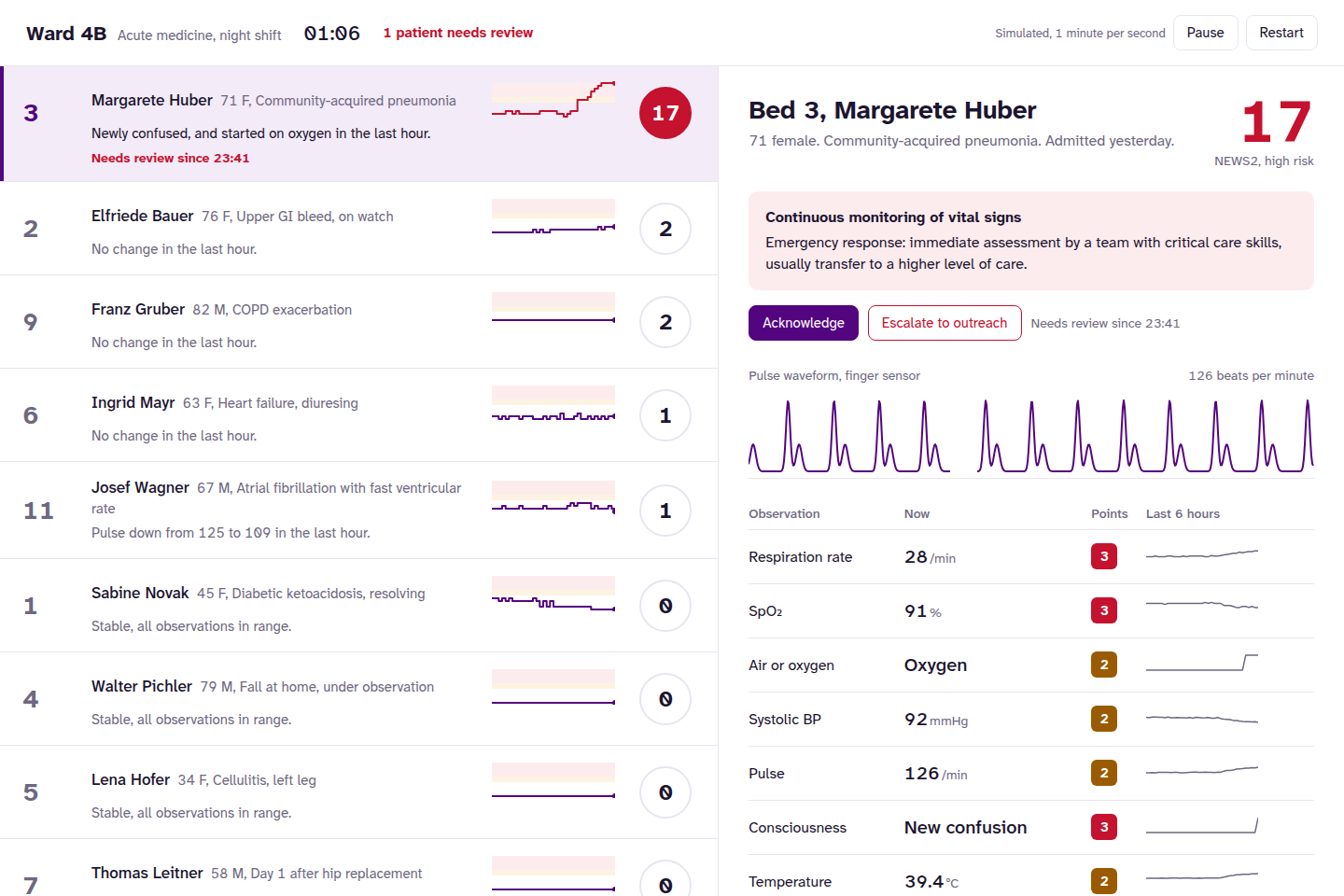
The ward at 01:05. Bed 3, pneumonia progressing to sepsis, has climbed to NEWS2 17 and sits at the top of the list, with six hours of trajectory beside the name and one sentence on what changed.
Three decisions
Sorted by need, not by bed number. Patients waiting for review come first, then by risk and score. When a patient deteriorates, their row moves up the list, visibly.
Trajectory, not just the latest value. Every row carries six hours of NEWS2 as a step line over the 5 and 7 thresholds, so "17 and climbing" and "5 and recovering" look different.
One sentence on what changed. "Newly confused, and started on oxygen in the last hour." Written from the observations, in the words a handover would use.
The selected patient shows the NEWS2 response the score requires, who to call and how often to observe, a live pulse waveform at the patient's current rate, every observation with its points, and six-hour trends on fixed clinical ranges, so noise looks like noise and a real change looks like one.
Clinical logic
NEWS2 is implemented from the Royal College of Physicians 2017 chart.
SpO₂ scale 2 applies to confirmed hypercapnic respiratory failure, the COPD patient in Bed 9. The same patient scored on scale 1 would trigger an urgent response for being at his prescribed target.
A single parameter scoring 3 raises the risk to low-medium even when the total is low. Bed 11, atrial fibrillation at 138, is that case. New confusion scores 3 on its own. Each risk band carries its response and its observation frequency.
Acknowledging a patient sets a reassessment time, 30 minutes at high risk and 60 otherwise. An overdue reassessment, or a rise to a higher risk band, puts the patient back at the top.
59 tests cover every NEWS2 band edge from both sides, both SpO₂ scales, the risk rules, the simulated patient courses, and the acknowledge and escalate workflow.
Eleven fictional patients follow common ward courses from 18:00: pneumonia
progressing to sepsis, a slow GI bleed, resolving diabetic ketoacidosis, COPD
on scale 2, fast atrial fibrillation, and stable patients. One bed is empty,
waiting for an admission. The simulation runs at one minute per second from
23:00, and ?at=01:00 on the URL opens it at any time between 18:00 and
04:00. The pulse waveform uses the same two-wave pulse shape as the tests for
my pulse monitor firmware.
Design
Typeface. Atkinson Hyperlegible Next, designed by the Braille Institute for low-vision legibility, with tabular figures. It is bundled with the app rather than loaded from a font host, so it works on hospital networks that block third-party requests.
Colour. White and one purple for interaction. Amber and red appear only where NEWS2 says they should, so colour always means something clinical.
Dim display for a dark ward at night, following the system setting or the button.
Keyboard. Arrow keys move between patients, A acknowledges, space pauses.
Phone. The list and the patient view become two screens.
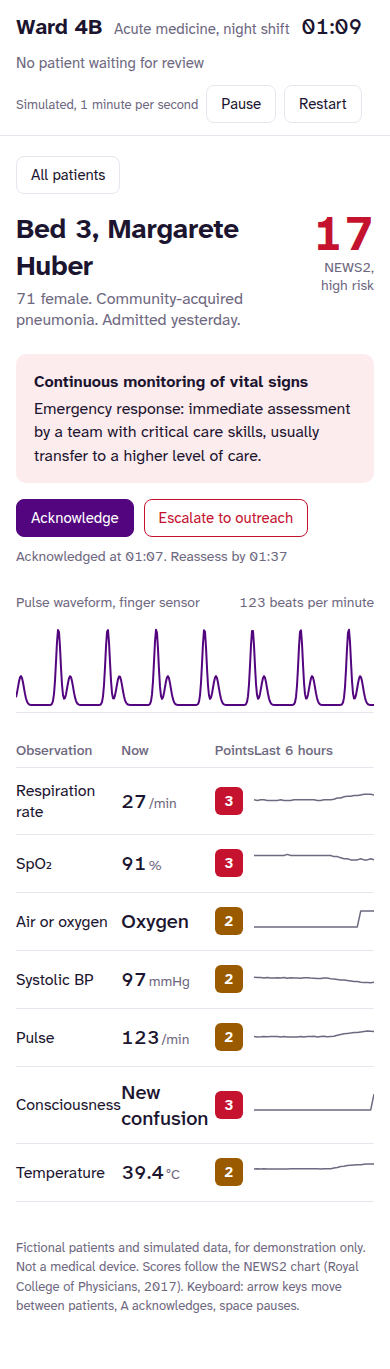
At phone width the list and the patient view become two screens.
Not a medical device
Fictional patients and simulated data, for demonstrating interface design and NEWS2 logic. It is not validated for clinical use and must not be used to make clinical decisions.