Case file
Chemsisy
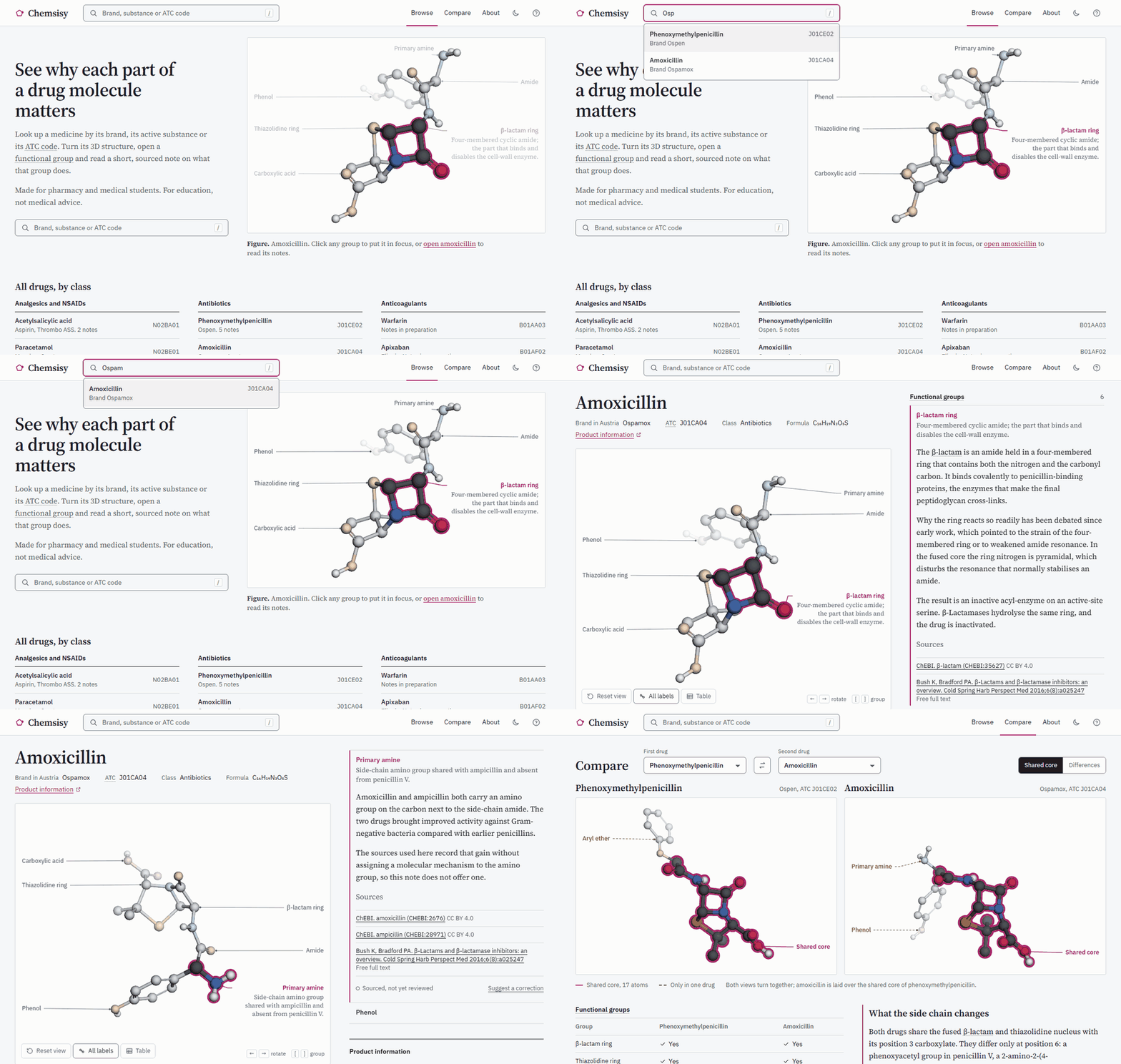
A free molecule explorer for pharmacy and medical students. Search a medicine by brand, substance or ATC code, and its 3D structure opens with each functional group found automatically and labelled like a textbook figure. Pick a group and the molecule turns it to the reader, with a short note on what that group does and the sources behind every claim. Two drugs can be laid over each other by the core they share. 36 drugs, offline after one visit. 227 unit and 18 browser tests.
- Author
- Henry CartoMSc · Software, Medical & eHealth Engineer
- Role
- Sole engineer and designer; author of the chemistry notes.
- Stack
- TypeScript · React · Vite · 3Dmol.js · RDKit · PubChem · MiniSearch · PWA · Vitest · Playwright · axe-core · GitHub Actions · Vercel
- State
- Live, open source. Notes sourced; review by a pharmacist or lecturer still to come.
Problem
Students meet a drug three ways: as a brand on a packet, as a substance in a lecture, and as a skeletal formula in an exam. The link between them, which part of the molecule does what, is usually a flat drawing in a textbook and a sentence saying "the β-lactam ring is essential". Turning that ring in three dimensions, seeing it next to the carboxylic acid that makes amoxicillin a zwitterion at body pH, or laying penicillin V over amoxicillin to see the one group that differs, needs software built for chemists, not for a seminar on a school iPad.
Chemsisy starts where students start: a brand name, such as Ospamox, Voltaren or Sortis, or a substance or an ATC code. The molecule opens as a labelled figure, and each label leads to a short note with its sources.
For education. Not medical advice. Chemsisy never gives indications, doses or side effects; every drug links to its official product information from the Austrian medicines agency or the EMA instead.
How it works
build time                                        in the browser
PubChem 3D conformers --+                         search (brand, substance, ATC)
53 SMARTS rules --------+--> RDKit --> JSON ----> 3D figure, labels, notes
notes in YAML ----------+    groups,    36 drugs  comparison by shared core
                             shared cores         service worker: offline
Everything that needs chemistry software happens once, at build time. RDKit matches 53 SMARTS patterns against each structure and finds the largest core every pair of drugs shares (509 pairs share six atoms or more). The app receives plain JSON and draws it with 3Dmol.js; it never runs a chemistry toolkit in the browser and never calls an API.
Design decisions
The molecule is the figure, labelled like a textbook
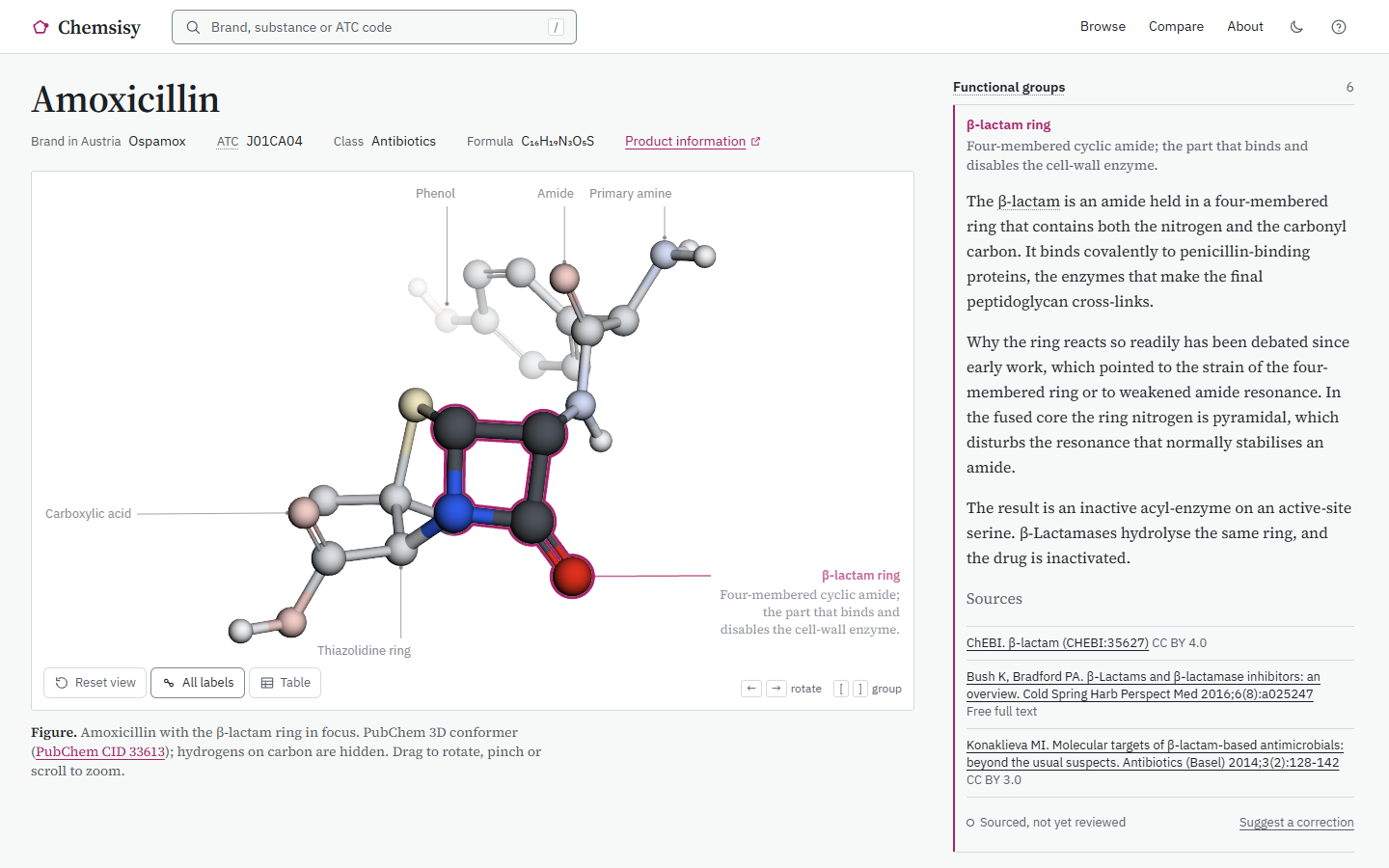
Each group gets a label, a leader line and, when in focus, a one-line caption. The placement is computed, not drawn by hand: a label may sit in a column or a row, and a candidate is rejected if its box or its leader touches an atom, a bond, another label or another leader. A label that cannot be placed cleanly is left out of the figure rather than drawn across the molecule; the list of groups beside it always names every one.
Focus turns the group to the reader
Picking a group turns the molecule so that a ring faces the reader with no atom in front of it, in 240 milliseconds, or at once with reduced motion. The group keeps its element colours with a thin outline; everything else fades. Nothing moves on its own: the molecule turns only when the reader asks.
Every claim names its source, and its review status
Notes are written in my own words, and each claim cites a source a reader can open: open-access reviews on PubMed Central, ChEBI and PubChem. Where the science is unsettled, the note says so and cites that. Where the only sources are paywalled, there is no note. Every note shows "Sourced, not yet reviewed" until a named person has checked it against its sources; the build refuses a reviewed note without a name and a role.
Comparing by the core two drugs share
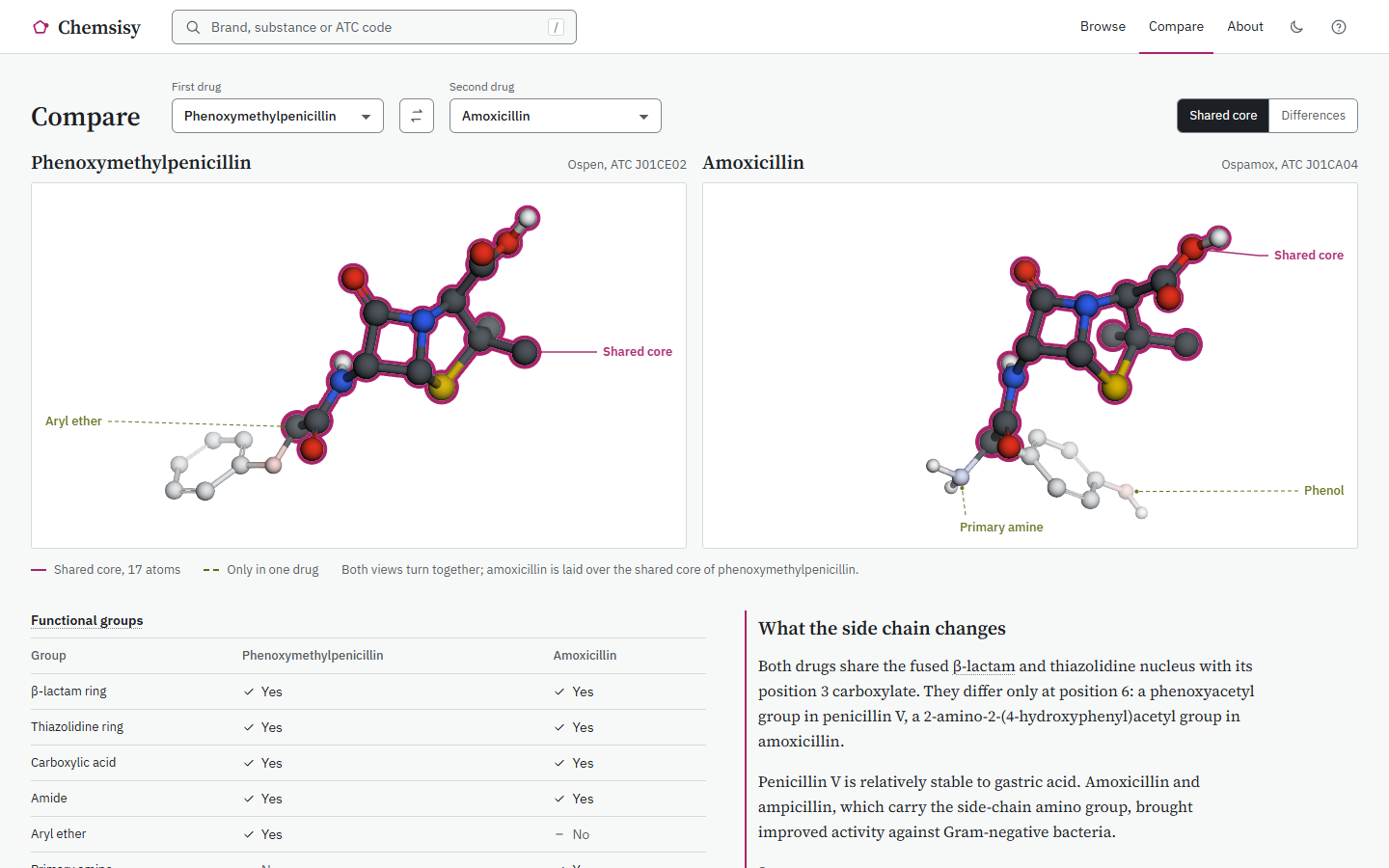
Two drugs are laid over each other by their largest common substructure, and both views turn together. The shared core is outlined in both; the groups that differ are labelled. A table lists, with Yes and No in words, which groups each drug has.
Built for a school's Wi-Fi
The whole starter set is bundled: 36 drugs, their structures and their notes, 1.8 MB for everything the offline cache stores. After one visit Chemsisy works with no connection, and it installs to a home screen. There are no accounts, no analytics and no cookies, and CI fails if personal data appears in any request the build scripts make.
Tests
227 unit tests and 18 browser tests, run in CI on every push.
The unit tests check every functional-group rule against molecules that must match and molecules that must not; brand, substance and ATC search with typos and German spellings; that every ring group in the starter set can be turned face-on; that across all 36 drugs, at desktop and at phone width, no leader touches the molecule or another leader; and that every note cites a source and that none gives a dose, an indication or a side effect.
The browser tests run at desktop and phone width. They open a drug and a comparison the browser has never loaded with the network off, use the 3D figure by keyboard, mouse and touch, and run axe accessibility checks on every page in light and dark.
Limits
- 36 drugs, with full notes for 12 so far. The others show their groups with "Note in preparation".
- No note has been reviewed yet. The chemistry review is under way; a review by a pharmacist or lecturer for the pharmacology side is still to come.
- Groups are found by pattern, so a group the rules do not describe is not shown. Overlapping matches keep the more specific name.
- One conformer per drug, from PubChem, or generated with RDKit where PubChem has none (clarithromycin, dabigatran etexilate). Real molecules move.
- On a narrow phone, a label that cannot be placed without touching another is left out of the figure; the list of groups still names it.
- No lookups beyond the starter set yet.
Sources and licences
Structures and properties come from PubChem (public domain), chemical classes from ChEBI (CC BY 4.0) and ATC codes from Wikidata (CC0), checked by hand. Product information is linked, never copied, from Medikamente Info Austria and the European Medicines Agency. Each note cites its own sources.
The code is MIT. The notes, glossary and drug list are CC BY 4.0, so teachers can copy them into slides or a course with a credit line. The repository has the full research behind the starter set under docs/research.